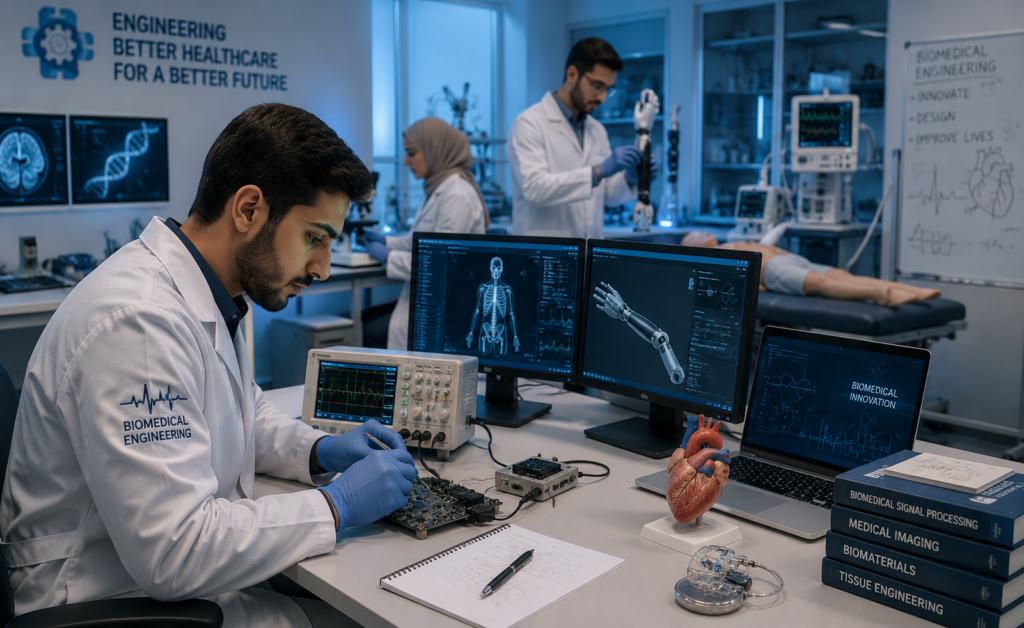
The Department of Biomedical Engineering applies engineering principles to medicine and healthcare — from the design of diagnostic equipment and prosthetic devices to the modelling of biological systems. Students gain expertise across mechanical, electrical, and biological domains, preparing them to contribute to Iraq's healthcare technology sector.
As Iraq's healthcare system modernises and expands, the need for biomedical engineers who can design, maintain, and innovate medical technology has never been greater. Our graduates bridge the worlds of engineering and medicine, creating solutions that improve patient outcomes and clinical efficiency.
Direction
Vision & Mission
Our Vision
To advance human health in Iraq through the development of biomedical engineers who bridge the worlds of engineering and medicine.
Our Mission
To educate biomedical engineers with the technical skills, clinical awareness, and innovative mindset to design effective healthcare solutions for the Iraqi context.
Academic Objectives
Departmental Goals
1Medical Device Design
Biomedical instrumentation
Signal acquisition and processing
Device prototyping and testing
2Biomechanics
Human motion analysis
Orthopaedic engineering
Prosthetics and orthotics design
3Clinical Engineering
Hospital equipment management
Medical device standards
Healthcare technology assessment
4Biological Systems
Physiology for engineers
Biomaterials science
Introduction to tissue engineering
Leadership
Head of Department
🧬
"Biomedical engineering sits at one of the most meaningful intersections in all of science — where engineering precision meets human care. Our graduates go on to design devices that restore movement, systems that save lives, and technology that transforms healthcare delivery in Iraq and beyond."
Dr. [Name]
Head of Department — Biomedical Engineering
Academic Focus
Specialisation Tracks
🏥
Medical Devices & Instrumentation
Design and development of diagnostic and therapeutic equipment including imaging systems, biosensors, and patient monitoring devices.
🦾
Biomechanics & Rehabilitation
Analysis of human movement and the design of orthopaedic implants, prosthetic limbs, and rehabilitation engineering solutions.
⚕️
Clinical Engineering
Management and maintenance of hospital technology infrastructure, ensuring medical equipment meets safety, performance, and regulatory standards.
Graduate Outcomes
Career Pathways
🧬
Biomedical Engineer
Design and develop medical devices, diagnostic equipment, and healthcare technology systems.
🏥
Medical Device Designer
Create innovative instruments and implants that address specific clinical needs and improve patient outcomes.
⚕️
Clinical Engineer
Manage and maintain medical equipment in hospital environments, ensuring safety and regulatory compliance.
🦾
Prosthetics & Orthotics Engineer
Design and fit customised prosthetic limbs and orthotic supports to restore patient mobility and function.
📊
Healthcare Technology Manager
Oversee the procurement, deployment, and lifecycle management of medical technology in healthcare facilities.
🔬
Medical Imaging Specialist
Work with MRI, CT, ultrasound, and X-ray systems — maintaining, calibrating, and optimising imaging equipment.