About the College
Our story, our direction, and the people building an engineering education that meets Iraq's needs — from infrastructure and energy to artificial intelligence and cybersecurity.
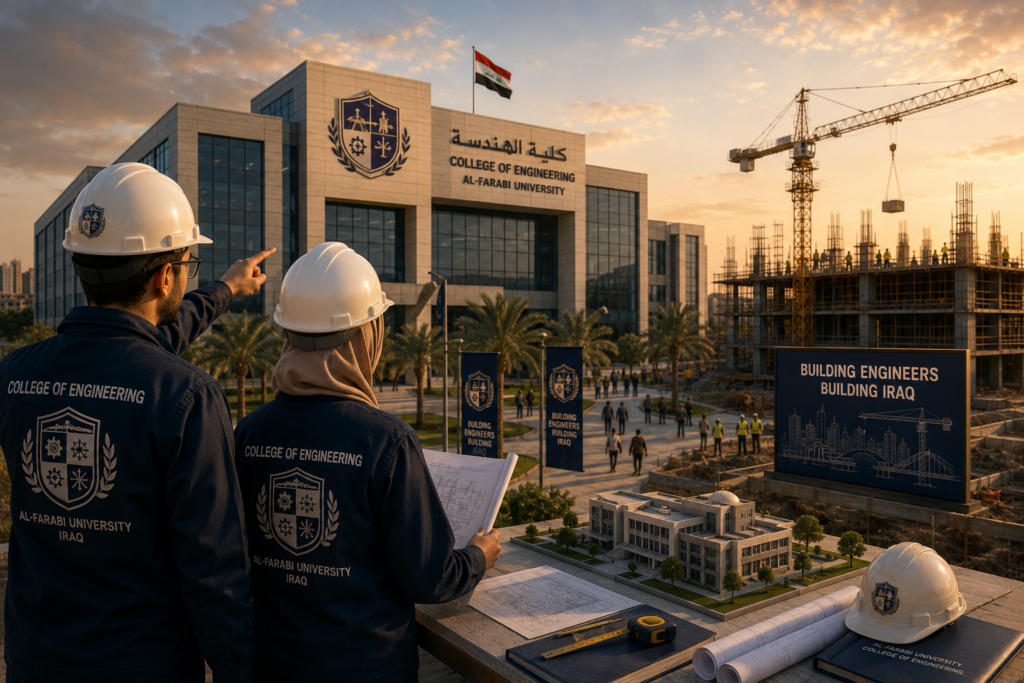
Building Engineers, Building Iraq
The College of Engineering at Al-Farabi University College was founded to address a clear and pressing need: Iraq's reconstruction, energy sector, and digital transformation all depend on engineers trained to international standards. We built the college around that mandate from the first day.
Across nine specialised departments, our programmes pair rigorous theoretical grounding with laboratory practice, industry placement, and applied research. Students move from fundamentals through to capstone projects that address real engineering problems, supervised by faculty who are active in their fields.
Our departments span the full spectrum of modern engineering — architecture, civil, petroleum, and petroleum refinery engineering alongside computer engineering, cybersecurity, UAV engineering, biomedical engineering, and artificial intelligence. It is a deliberately broad portfolio, chosen to match the disciplines Iraq needs most as it modernises.
All programmes are delivered under the accreditation framework of the Iraqi Ministry of Higher Education and Scientific Research, and our curricula are reviewed continuously against international engineering education benchmarks.
Vision & Mission
Our Vision
The College of Engineering at Al-Farabi University aspires to be a leading and distinguished academic institution in the fields of engineering education and scientific research at both the local and international levels, through the delivery of high-quality educational programmes and an active contribution to achieving sustainable development and building a knowledge economy, in alignment with global academic standards.
Our Mission
The College of Engineering at Al-Farabi University is committed to providing rigorous engineering education grounded in modern scientific foundations and accredited academic standards, and to preparing academically and professionally qualified engineering cadres who possess skills in innovation, critical thinking, and teamwork, and who are capable of meeting labour market demands. The college also seeks to promote applied scientific research, provide engineering services and consultations, and build effective partnerships with community institutions, thereby contributing to community service and comprehensive development.
Our Goals
Education & Learning
Scientific Research
Community Service
Quality & Accreditation
Human Resources & Institutional Development
Cooperation & Openness
Values & Social Responsibility
Our Core Values
Excellence
We hold teaching, research, and professional practice to the highest standards, and we measure ourselves against international benchmarks rather than local convenience.
Innovation
We encourage creative problem-solving and back it with the facilities to test ideas — from prototyping labs to applied research projects with real constraints.
Integrity
Engineering decisions carry public consequence. We build honesty, transparency, and accountability into how we teach and how we expect our graduates to work.
Community
We foster an inclusive, collaborative environment for students, staff, and partners, where mentorship and peer learning are part of the everyday culture.
Research Culture
Faculty who publish bring current developments straight into the lecture hall, and students are drawn into that work through supervised projects and co-authorship.
National Service
Our programme choices follow Iraq's needs — energy, infrastructure, digital security, and healthcare technology — so that graduates contribute where they are needed most.
Dean's Message
Welcome to the College of Engineering at Al-Farabi University College. Engineering is, at its core, a discipline of responsibility — every bridge, every network, every refinery process carries the weight of the people who depend on it. That conviction shapes how we teach.
We have invested deliberately in three things: qualified faculty who remain active in research and practice, laboratories that let students work with the tools they will actually use, and partnerships with the Iraqi firms and institutions where our graduates will build their careers. Together these make the distance between the classroom and the profession as short as we can reasonably make it.
To prospective students: you are choosing a demanding path, and we will hold you to it. In return you will graduate as an engineer who can be trusted with real work. I invite you to explore our departments, meet our faculty, and become part of a community that is building Iraq's next generation of engineers.
History & Milestones
College Established
The College of Engineering was founded within Al-Farabi University College, with a founding mandate to train engineers for Iraq's infrastructure, energy, and technology sectors.
First Student Intake
The college welcomed its inaugural cohort across its founding departments, alongside the appointment of its first full-time academic staff and the commissioning of core teaching laboratories.
Nine Departments
The academic portfolio expanded to nine specialised departments, adding UAV engineering, cybersecurity, and artificial intelligence to the traditional civil, petroleum, and architectural disciplines.
Research & Industry Growth
Faculty research output expanded across departments, supported by new laboratory investment and formal partnerships with Iraqi engineering firms offering student placements.
Accreditation & Affiliations
The College of Engineering operates under the accreditation framework of the Iraqi Ministry of Higher Education and Scientific Research. Every programme we offer is reviewed and approved under that framework, and our degrees carry full national recognition.
Beyond national accreditation, we maintain academic partnerships with universities and research institutions regionally and internationally. These relationships inform our curriculum reviews, support faculty development, and open research collaboration to our staff and senior students.
Our curricula are benchmarked against international engineering education standards, so that graduates are positioned to pursue postgraduate study or professional practice outside Iraq as readily as within it.
Ministry of Higher Education & Scientific Research
All nine engineering programmes are accredited and recognised nationally under the Iraqi MoHESR framework.
Regional & International Partnerships
Active academic links with universities and research institutions supporting curriculum review and staff development.
Industry Collaboration
Working relationships with Iraqi engineering, energy, and technology firms providing placements and applied project work.
International Benchmarking
Programme content mapped against global engineering education standards and reviewed on a continuing cycle.